Challenge C: OER
Practicing Mindfulness Through Creativity
Updated: November 4th, 2025
Authors: Hailey Godfroid, Julia Snidanko, Alexis Moore
Our team consists of Hailey Godfroid, Julia Snidanko, and Alexis Moore. We chose this topic as it connects to each of our fields of study, with Julia and Alexis studying psychology and Hailey studying visual arts. As university students, our goals are to help other students successfully manage their stress levels and develop the cognitive skill of mindfulness.
Final product:
THE PROCESS
Understand (Discover, Interpret, Specify)
DESCRIBE THE CHALLENGE:
University students need to learn healthy coping mechanisms during peak times of stress, such as exam season.
CONTEXT AND AUDIENCE:
Audience
Our audience consists of university students who are aware of healthy coping mechanisms but are unsure how to apply them in their daily lives. They may understand the concept of mindfulness or stress management in theory, but lack the knowledge of what techniques can be used. An extreme case within this group would include students who have little to no familiarity with mindfulness as a coping strategy for stress. Demographically, this audience is typically between the ages of 17 and 30 and enrolled in post-secondary education. They are open-minded individuals who are motivated to adopt new strategies to manage stress during the peak academic periods. Psychographically, they may enjoy creative activities and show an interest in mindfulness-based practices. These students generally have positive attitudes toward maintaining their well-being and look for a balance between academic success and mental health. Behaviourally, they demonstrate openness to seeking support when needed and are receptive to learning and implementing new coping methods.
Needs
University students who feel overwhelmed with coursework need to learn how to navigate their stress successfully. The audience targeted needs to learn how to balance stress levels, as it helps maintain an objective awareness of one’s thoughts and feelings. They will need to develop the cognitive skill of mindfulness to better manage their stress levels. This can be done through engaging in creative hobbies such as journalism and art. Students engaging in creative mindfulness activities will need simple writing and drawing utensils, as well as a safe environment and time to go uninterrupted.
Goals
The goals of our audience are to confidently navigate stressful situations when stressors arise in their day-to-day university life. They will be able to navigate these stressful periods by equipping them with coping strategies to express themselves. We want the students to feel empowered to intentionally choose healthy techniques when faced with emotional or academic strain, rather than reacting impulsively or avoiding stress. By the end of this activity, our students should hopefully be able to recognize their stress responses, apply at least one mindfulness-based technique, and reflect on how these practices help them regulate their emotions.
Motivations:
The target audience’s motivations come from the desire to obtain overall good marks. Without knowing healthy coping mechanisms, well-being can be negatively impacted, therefore not allowing students to reach their highest academic potential. The audience’s motivation levels will range from person to person, which is why the activities provided will be easily accessible and at a low cost. To keep activities engaging, it will be up to the individual to decide how much or how little effort to put into the activities.
POV STATEMENT:
A stressed-out university student needs to learn and apply healthy coping skills so that they can successfully self-regulate at times of need
LEARNING OBJECTIVES:
Primary objectives:
- Students will understand the importance and benefits of practicing mindfulness, as well as identify when to apply it to situations.
- The audience will be able to better self-regulate their stress levels throughout the semester.
Secret Objectives:
- Encourage students to engage in creative hobbies, or possibly spark an interest in trying new things.
- Help students broaden their cognitive capacity in order to achieve their academic goals.
Plan (Ideate, Sketch, Elaborate)
IDEATION:
The brainstorming process:

From brainstorming, we decided that we wanted to focus our prototype specifically on two topics of coping strategies. From that, we felt our most promising prototype was both art and journaling.
SCRIPT:
The journal prompts, which is a downloadable PDF document, were created to fill out at the end of the day. It should be easy to follow and showcase the emotions that you are feeling that day. By doing this daily, we hope that you feel better as the week progresses with step-by-step planning and the hopes of reframing negative challenges that occur into positive learning lessons.
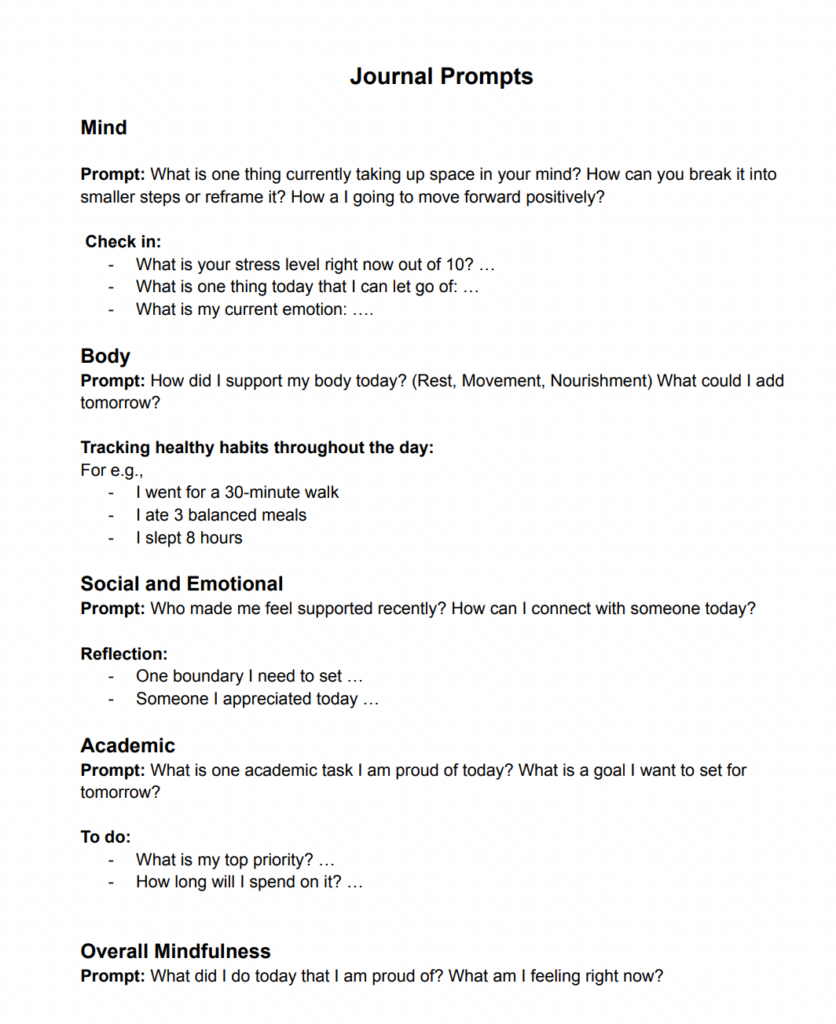
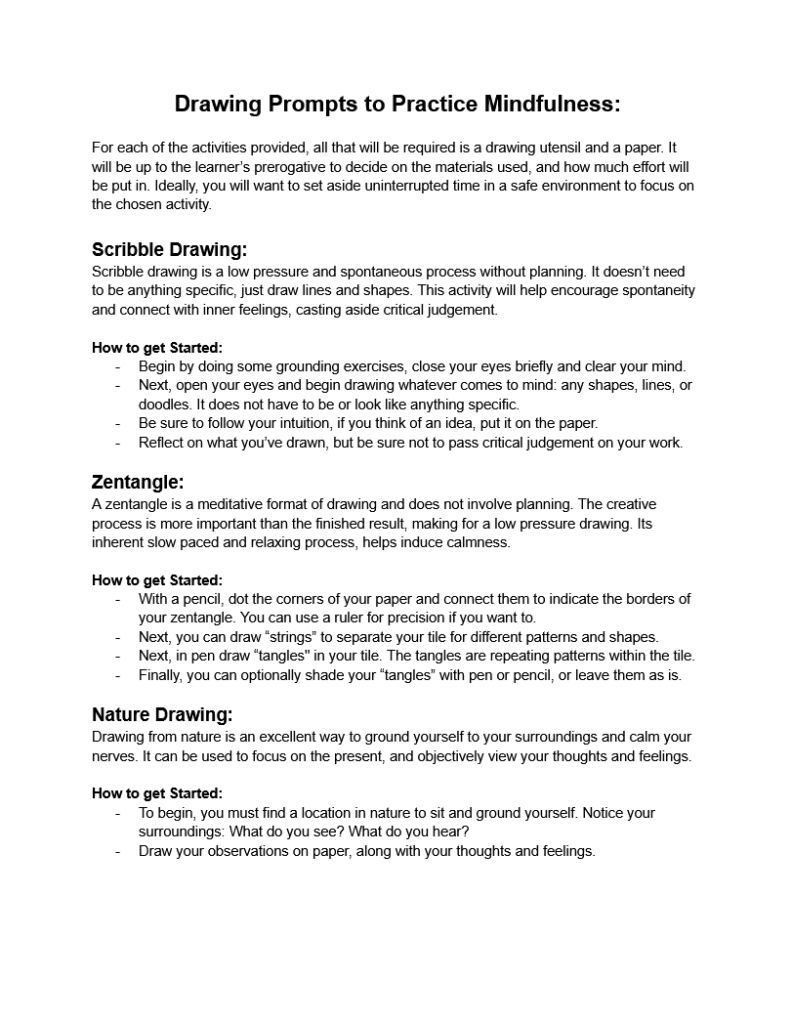
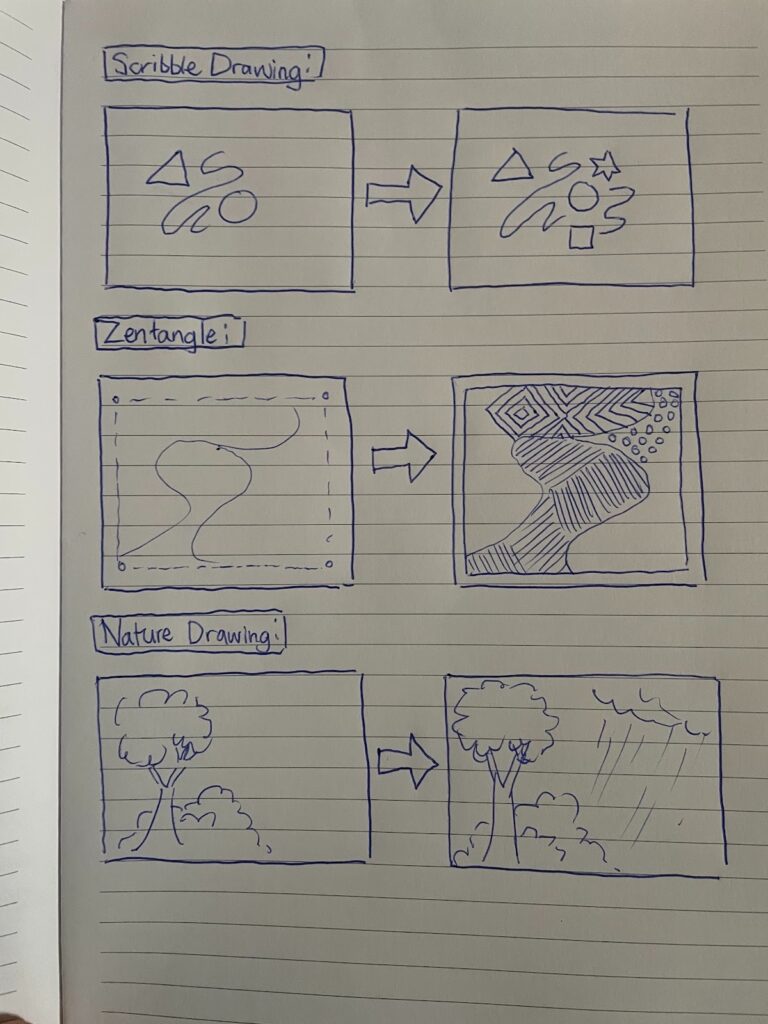
Prototype Example:
PRINCIPLES APPLIED:
Dual coding theory is the principle in which learners engage in both visual and verbal channels, allowing for additional capacity when processing new information. As creative hobbies are inherently a very visual process, the dual coding principle will be utilized throughout the drawing document to help guide learners through the process. Learners will be engaged with imagery to help them break down the drawing process.
The signalling principle is the principle where visual cues highlight key information, and will be applied through the use of headers and markers, allowing the learner to note areas of significance. This principle will be used throughout both documents, signifying the various steps and prompts throughout their processes.
Self-Pacing Principle (branch of segmenting): Students can complete the prompts at their own pace and revisit them as needed. This aligns with mindfulness practices that involve intentional reflection.
PEER FEEDBACK:
Julia’s Feedback:
The first peer reviewer, Kvirdi, highlighted the strength of the group’s topic choice and noted that the goal of creating a low-cost, highly accessible activity was clearly reflected in the prototype. She suggested further strengthening accessibility by incorporating features such as strong contrast, text for images, and consistent formatting. She also recommended adding a reflection activity to enhance student engagement with the OER. Similarly, the second reviewer, Hanna, encouraged including a brief reflection component, particularly following the drawing practice, and commented on the overall relevance of the topic, noting that it reaches and relates to a wide range of university students.
Hailey’s Feedback:
When looking over the feedback received from my peers, several strengths and areas for improvement were pointed out to me. In terms of strengths, it seemed that the topic my group and I had chosen was compelling, and it had a clear goal that was conveyed relatably to university students. It was mentioned that the overall explanation of mindfulness was done well; however, the prototype could be improved upon by further tying in how the creative prompts will engage in mindfulness. My peers had also mentioned adding further context on how to get started for beginners who may be new to each of the topics: mindfulness, drawing, and journaling.
Alexis’s Feedback:
The peer feedback highlighted several strengths of the group’s work. It explained that the topic was extremely relatable and that the overall breakdown of our project was clear. They both mentioned that our OER was accessible and easy to follow. Reviewers also commented that the OER appeared accessible and user-friendly. A peer misinterpreted the purpose of the OER. This indicated a need for clarification in the introduction. While the critique could not be incorporated due to misalignment with the project’s goals, it demonstrated the importance of ensuring the project is as clear and concise as possible.
Reflect and Refine
TEAM REFLECTION:
Our peer feedback highlighted several aspects of our prototype that worked well, particularly the clarity, accessibility, and relatability of our topic. Reviewers consistently noted that the concept of mindfulness presented through creative activities was easy to understand and relevant to university students. They also emphasized that our explanation of mindfulness and the instructions for both activities were clear and straightforward. These strengths align closely with Mayer’s Personalization Principle, which suggests that learners engage more effectively when content is presented in a conversational and relatable tone (Mayer, 2021). By using accessible language and step-by-step guidance, our prototype encouraged learners to connect with the material in a meaningful way.
Through receiving peer feedback, one reviewer voiced that certain parts of the project were initially unclear. To address this, our group thoroughly reviewed the prototype to identify potential gaps in explanation. We decided that making our introduction very detailed would help ensure that learners clearly understand what mindfulness is, along with the overall goals and benefits of the project. This revision supports the cognitive theory of multimedia learning, which emphasizes the importance of clearly structured information to reduce extraneous cognitive load and enhance comprehension (Mayer, 2021).
We made several revisions to improve accessibility and learner engagement. To do so, we ensured that our fonts had strong legibility and that colour choices provided sufficient contrast. We also used varying colours and text sizes to highlight areas of importance and sections, reinforcing the segmenting principle by breaking information into manageable steps (Mayer, 2009). Furthermore, we expanded the journaling and drawing activities to make their connection to mindfulness more explicit, adding reflection questions before and after each activity. This reflective component allows learners to consider their emotional responses, helping to personalize the learning experience and deepen engagement, particularly since drawing alone may not inherently prompt emotional reflection.
Open Educational Resources (OERs) are a strong form of multimedia learning because they are freely accessible and can be used independently by learners at their own pace. Our downloadable PDF incorporates several multimedia learning principles, including dual coding, which pairs imagery with text to enhance understanding (Paivio, 2014). While the OER format is effective in guiding learning, one limitation is the lack of features such as real-time modelling or audio guidance, which some learners may prefer. Although we mitigated this limitation through detailed instructions, explicit prompts, and illustrative visuals, certain learners may still benefit from different multimedia formats to fully translate instructions.
INDIVIDUAL REFLECTIONS:
Julia’s Reflection:
My role in this project focused primarily on the design components. I entered this course with some digital editing skills, and throughout the semester, my ability to do so really strengthened. Since I have built this confidence, I took the lead on designing the final document in Canva. Meanwhile, Hailey and Alexis took the lead on a majority of the written components, such as the drawing and journaling prompts. The introduction page was done collaboratively, and I created the mindfulness and creativity sections, along with the subparagraph in journaling describing the tools needed and the environment in which to journal. We learned many lessons from our last project, so our communication skills and overall project smoothness were much stronger this time. We had several calls to discuss the major stages of our project, such as initial ideation, receiving peer feedback, and final editing. Due to conflicting schedules, a lot of our communication between these meetings was through text messages, but this regular communication really supported the project’s progress. In our calls, large sections were completed together to ensure the workload did not feel overwhelming. Overall, the lessons from our previous project clearly contributed to our collaborative success on this one.
Hailey’s Reflection:
After receiving peer feedback and working together with my group, I was able to refine several pieces of my portion of the final project. For example, I was able to implement more in-depth drawing instruction and images as per the suggestion of my peers. As a group, we had all concluded that we could connect our activities to mindfulness better by adding an emotional reflection question for learners to fill out before and after completing the activities.
When reflecting on the process, I felt as though our communication for this project was overall strong, and we had each contributed substantial changes to our finalized project. Julia had done an excellent job of navigating Canva to create a visually aesthetic document. During this time, Alexis and I had worked together to help elaborate on the writing portion of our blog post. Although we did a good job communicating, we found it hard to set aside time to meet due to our conflicting schedules. We tried to mitigate this by communicating over text and implementing information into the document bit by bit as the project was in the construction phase.
Alexis’s reflection:
In this project, my main contribution included developing the initial idea for our OER, creating the journal prompts and helping organize the structure of the project. I focused heavily on ensuring that the purpose of our resource was clear and that the journaling activities were meaningful and something people would actually use. I wanted to make sure that this OER is something I could incorporate into my daily routine. After receiving feedback, I felt more confident in our idea of our OER and made sure the reason for the project was as clear as possible. Throughout this process, I felt as though our teamwork was much stronger compared to our previous assignment, and we were really on top of communicating with one another. Even though coordinating our schedules was challenging at times, we were all consistent with texting and meeting when possible, and we started early enough that if any conflicts came up, we could solve them right away. This allowed us to divide up tasks effectively and build on what we could have improved on last time. Julia did a great job on the design aspect of the Canva and our final draft of the OER project. Hailey did a great job of creating the drawing prompts; she is a fine arts major, which aligned with her background of studies. Overall, I am happy with how well we collaborated and how much we improved from our previous assignment, and I feel as though our final product reflects our growth.
References
Mayer, R. E. (2009). Multimedia learning (2nd ed.). Cambridge University Press.
Mayer, R. E. (2021). Multimedia learning (4th ed.). Cambridge University Press.
Paivio, A. (2014). Mind and Its Evolution (1st ed.). Taylor and Francis. Retrieved from https://www.perlego.com/book/1556154/mind-and-its-evolution-a-dual-coding-theoretical-approach-pdf